The bill has gone — how do I fix it honestly?
A second document with its own date — the filed month stays untouched.
The Tuesday it gets opened
Goods come back three weeks after the bill. A rebate is agreed at quarter end. A short delivery surfaces at the customer’s gate.
The old way, stated fairly
The bill is corrected with a pen, or "adjusted in the next invoice" — and every version moves revenue into a month that was already filed.
How it earns its place
A second document, not a rewrite
Its own number, its own date, its own GSTR-1 line. The invoice stays exactly as sent.
Money and goods are separate facts
Restock is a tick per line — a returned pallet and a rebate can share one note, and a rebate can’t sit on a shelf.
A credit is not a payment
The note makes the bill smaller. It never marks it "paid" — the person chasing money reads a true list.
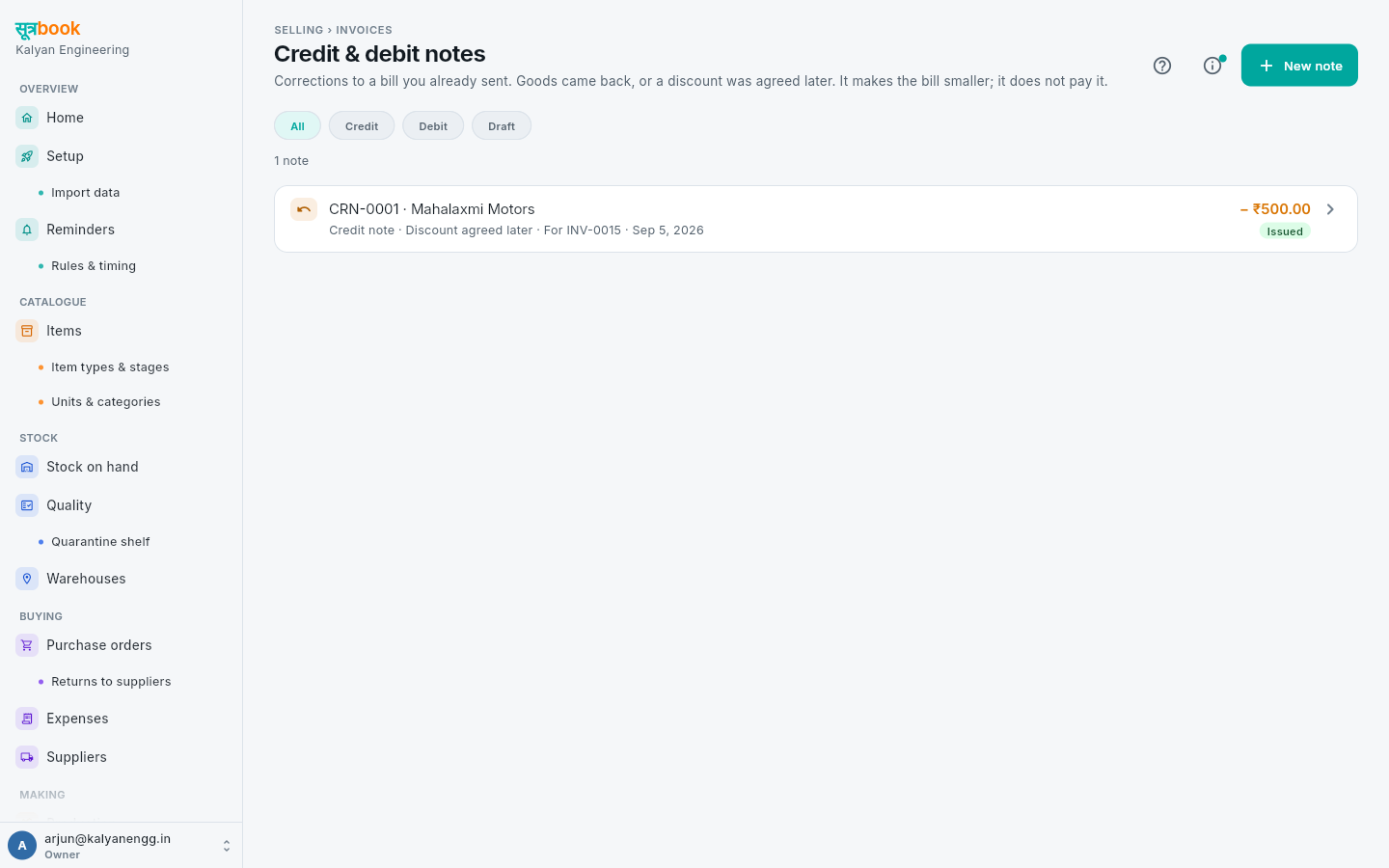
A rate difference agreed on the phone becomes CRN-0001 against the bill — ₹500 off, on today’s date, in this month’s GSTR-1. The bill shrinks; the filed month never moves.
What it refuses, and why
Software that explains its “no” is software an owner can trust.
More credit than the bill has left
Counted across every note — three people on one complaint can’t credit ₹40,000 against a ₹10,000 bill.
Cancelling a note that moved goods
The books and the shelf would part company forever. Issue the opposite note — which is what GST expects.
A note against an old-system bill
Its tax was filed there, not here.
Connected on the thread
Nothing here stands alone — the same entry feeds these too.
See it with your own material
Bring the Excel you already keep — the import wizard reads it as it is.